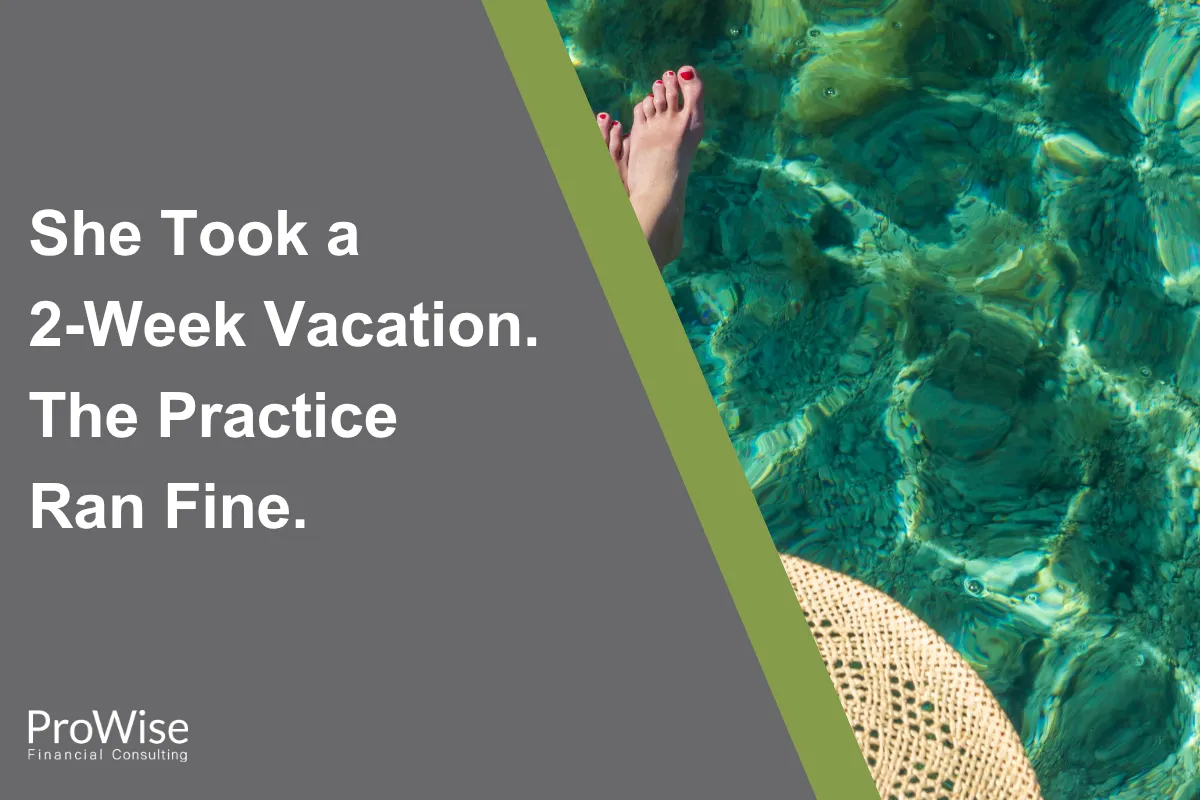
She Took a 2-Week Vacation. The Practice Ran Fine.
She Took a 2-Week Vacation. The Practice Ran Fine.
Last summer, Dr. Renee took her first two-week vacation in nine years. Somewhere over the Atlantic, she realized she hadn't checked the practice bank account once.
Let me tell you how she got there. She's a composite - stitched together from real optometry practices I've worked with, numbers rounded, details blended. The arc is one I've watched happen more than once.
Before: She Was the Practice
On paper, Dr. Renee was doing great. Collections around $1.4 million. A full schedule. She'd even brought on an associate a year and a half earlier.
And she was wrung out. Five clinical days a week, every week. If she wanted a day off, she felt it in the deposits. "If I'm not in the chair, we don't get paid," she told me. She believed it, because for years it had been true.
She paid herself last, whatever was left after everyone else. Some months that was decent. Some months it was nothing. She was the only one who could pull a report or approve a purchase. She owned the place, but it didn't feel like she owned it. It felt like it owned her.
If you've read along this month, you know the name for all that. Symptoms. A margin propped up by her own underpaid work. Money that moved only when she did. One person - her - holding every financial decision.
The Turn: She Stopped Grinding and Started Building
Here's what she didn't do. She didn't just decide to work less and hope. She'd tried that. It never held.
We built the boring stuff instead. Buckets, so the cash sorted itself into taxes, her pay, profit, and the rest, instead of living in one account and her head. That's the Profit First approach in plain terms. Her own pay went on autopilot - a set draw, same day every month, first instead of last. And we got a second set of eyes on the numbers, plus a short monthly money meeting that ran whether or not she was the one running it.
Then the associate. She'd hired the extra doctor but never looked hard at whether it was working, because the numbers were too tangled to tell. Once they were clean, the answer was obvious. The associate was profitable, and there was room to lean on that. A clear picture and a real second provider is a big part of what makes a healthier, more productive practice. It also meant Dr. Renee wasn't the only one who could generate a dollar.
After: Optional, in the Best Way
Within a few months, the practice ran on rhythms instead of on her.
She cut her own schedule from five clinical days to four. Her pay showed up the same every month, on time, including the two weeks she was gone. When something came up while she was away - a vendor question, a big invoice - someone handled it inside the rules she'd set. The money didn't wait for her to get back.
Her return on ownership grew too. The money she earns for owning the business, not just working in it. And it didn't grow because she saw more patients. She saw fewer. It grew because she could finally see it and steer it.
That's what "optional" means here. Not gone. Not checked out. Just no longer the one point everything runs through. The practice could function, and pay her, without her standing in the middle of it.
What Got Her There
Notice what didn't change her life. Not working harder. Not caring more. She already did plenty of both.
What changed it was a handful of simple systems and a clean look at her own numbers. Whether you own a practice or a job, the symptoms you can read, the systems you can build - that was the whole month, and Dr. Renee is what the other side looks like. A doctor who built something that runs, pays her, and hands back her time.
That's the point of all of it. Not a bigger practice. A freer owner.
Want to Become Optional Too?
If you want your practice to run and pay you whether or not you're in the building, that's the work we do together. Click here to Book Your Financial Clarity Call and we'll find where your practice still leans on you, then build the systems that set you loose.
To your abundant practice,
Eric Levenhagen, CPA CTS
Eric Levenhagen, CPA CTS, is the only financial consultant who helps private practice optometrists improve the financial health of their practice with a simple process called Financial Harmony, designed to reduce their taxes and increase their after-tax profits so they can reach their personal goals faster.
ProWise Tax & Accounting LLC Disclaimer: This blog is intended for educational purposes and provides general information about tax, accounting, and small business topics. The owner described is a composite created for illustration and is not a specific client; figures are rounded and illustrative. This is not professional advice, and using this blog does not create a client/CPA relationship between you and ProWise Tax & Accounting, LLC dba ProWise Financial Consulting, or its owners and employees. Blog posts are based on tax rules in effect at the time they are written, and older posts are not always updated for changes. Tax rules change frequently. Always check with your CPA or accountant regarding the most current rules and how they apply to your specific situation.
